Wednesday, December 19, 2018

World Weatherwatch: Tropical Cyclone Owen in Queensland, Australia; flash flooding in South Africa; and a heavy snowstorm in the central US

A vehicle passes puddles of water on the side of the road in Cairns, Queensland, Australia.


Tropical Cyclone Owen brought flash flooding, storm surges and destructive winds to Queensland, Australia in the last week. Gaining its strength over the Gulf of Carpentaria, it made landfall on Saturday morning as a category 3 cyclone and brought winds gusts up to 124mph and torrential downpours – 17cm of rain fell in just two hours in places on the Cape York Peninsula. Weakening to a tropical low, it then continued to track down Queenland’s east coast, with further torrential downpours causing flash flooding to Whitsundays and Central Coast regions, before moving offshore into the Coral Sea on Monday.
Extreme flash flooding has also hit parts of South Africa, as a sudden extreme hailstorm occurred on Saturday in Sun City, to the northwest of Johannesburg. The hail caused damage to building and vehicles, forcing holiday makers to evacuate the area.
In America, a heavy snowstorm swept through south-eastern states on the weekend of 8th-9th December. The highest snowfall total was received on Mount Mitchell in North Carolina, where 86cm fell. The weight of the snow brought power lines down, with 300,000 people affected by electricity outages. A large number of flights were cancelled and 670 vehicle collisions were reported in North Carolina.


Thursday, October 11, 2018

World weatherwatch: Japan and South Korea hit by tropical storm Kong-Rey

Last week ex-typhoon Kong-Rey became the ninth tropical system to hit Japan this year. Despite its category 5 status downgrading to tropical storm intensity before landfall, it produced damaging winds, storm surges, torrential rain and flooding across many parts of Japan and South Korea. Tracking across Japan’s southern islands, it reached South Korea on Saturday, before moving north-eastwards over northern Japan on Sunday. Sustained winds of 115mph (185km/hour) and wind gusts reaching 143mph were recorded, while dumping up to 75mm (3in) of rain an hour. The warm air associated with it exceeded Japan’s highest October temperature record, reaching 36C (96.8F) in Sanjo, Niigata Prefecture.

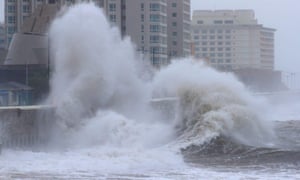
Waves crash into a sea wall during heavy swells from ex-typhoon Kong-Rey, on Jeju island, South Korea

Ex-hurricane Rosa made landfall in north-west Mexico on Monday last week, causing flooding there before bringing torrential downpours to the south-western US. It produced the wettest October day on record for Phoenix, Arizona, with 60cm of rain falling in 24 hours, causing flooding and leaving people trapped in vehicles. It is unusual for Pacific hurricanes and their remnants to reach such high latitudes.

Meanwhile, drought-stricken parts of eastern Australia received much-needed heavy downpours throughout last week, triggered by a trough of low pressure that sat over New South Wales. Some towns received more rain in 24 hours than they have all year; the village of Pooncarrie recorded 53mm last Wednesday.

Link to Gaurdian feature: https://www.theguardian.com/weather/2018/oct/10/world-weatherwatch-japan-and-south-korea-hit-by-tropical-storm-kong-rey-ex-hurricane-rosa

Friday, August 3, 2018

Research Study: Re-simulating Hurricane Katrina

1. Introduction


Hurricane Katrina, in August 2005, was the costliest natural disaster in history to hit the United States, with an estimated $108 billion of damage to property, as well as 1833 deaths (FEMA, 2007). It had become a hurricane ( winds > 33m/s) just before making landfall in Florida on the 25th. As the hurricane passed over the warm waters of the Gulf of Mexico, it rapidly intensified. As Fig.1a shows, by 0000UTC on the 28th, maximum wind speeds were above 50m/s, hence a category 3 hurricane. The hurricane deepened further - shown by decreasing pressure in Fig.1b – and wind speeds also increased. A maximum wind speed of 78m/s was recorded at 18000UTC on the 29th, although this is not present in Fig.1a. A minimum hourly surface pressure of 941hPa was also simulated at this time (Fig.1b). This value is much higher than the 902hPa minimum observed (NOAA, 2005). These underestimations are discussed in Sec. 4.2.

Fig.1 a) Maximum and minimum wind speeds, b) Minimum surface pressure, in the vicinity of the hurricane on 28th and 29th August 2005.

2. Method


The WRF model was used to simulate the progress of Hurricane Katrina. Using ‘ncview’ to plot the water vapour mixing ratio (QVAPOR), the hurricane’s synoptic-scale structure could be interpreted (Fig.2). From this, the hurricane was considered to be strongest, whilst still approximately symmetrical, at 1000UTC on the 29th. This time is therefore used in the subsequent analysis. The model is initialised at 2005-08-28_00:00 UTC.

Coordinates were then taken in the zonal, west-to-east direction through the centre of the hurricane, which were used in cross sections of various quantities. Potential temperature contours were overlaid on each vertical cross section to allow for easy identity of the location of the eye column.
Plan views of cloud types were also plotted, using the assumptions:
Stratiform cloud where w < 1 m/s, with liquid or mixed-phase cloud and precipitation hydrometeors.
Cirriform cloud where w < 1 m/s, with ice-only cloud.
Convective cloud where w > 1 m/s.

All scripts were then re-ran under a new parameterisation scheme (Sec.4.2). The coordinates used in the cross section plots were changed, in order to transect through the eye of the storm for comparison of the different schemes. Although this will capture the hurricane in a different stage of its development, simple comparisons of the hurricane’s structure can be made.


3. Results and analysis

3.1 Structure


Katrina had a classic hurricane structure. In the northern hemisphere, the flow around a surface low pressure is cyclonic (Fig.3a). Gradient wind balance exists, but this is disrupted by turbulent friction at low levels, causing the flow to be deflected towards the low pressure at the centre of the system. The low-level winds spiral towards the low-pressure centre, causing large horizontal convergence in the eye wall. By the conservation of mass, this leads to strong ascent in this region (Fig.3b), setting up a thermal direct circulation: the ascending air rises and flows outwards in the upper levels. Fig.3a-b can be used to interpret that the radial velocity would be large and positive where there is the inflow, decreases with height, and would become negative where there is the outflow.

The kink in the potential temperature contours (Fig.3c) indicates the upward advection of ascending air in the eye wall and the downward advection of descending air in the eye. As the air rises in the eye wall, it rapidly cools, allowing relative humidity to increase to, or close to, 100% (Fig.3d). This initiates the rapid growth of the cloud-liquid amount (Fig.4a), and deep convective cloud forms (Fig.4c), producing a very high total precipitation hydrometeor amount in the eye wall region (Fig.4b).


Fig.3 West-east vertical cross section (looking north) of a) horizontal velocity, b) vertical velocity, c) potential temperature, and d) relative humidity, valid at 2005-08-29_10:00UTC. Horizontal velocity is negative to the west of the eye and positive to the east of the eye – hence cyclonic flow.


Fig.4 West-east vertical cross section (looking north) of a) cloud-liquid amount, b) total precipitation hydrometeor amount, and c) a plan view of convective cloud, valid at 2005-08-29_10:00UTC.

      3.2 Dynamics


In the Northern Hemisphere, the Coriolis force causes low pressure systems to have cyclonic flow, which is seen in the lower levels on Hurricane Katrina (Fig.5a). However, latent heat release and warming builds high pressure aloft, generating a strong upper level pressure gradient. This causes the upper level outflow to become anti-cyclonic. This can be seen in Fig.5b by observing the clockwise outward-spiralling wind barbs. This process also results in the strongest winds being close to the surface and decreasing with height, which can be seen in Fig.3a and by comparing the magnitude of the wind barbs in Fig.5.


Fig.5 Plan view of wind barbs at a) 950hPa and b) 200hPa, valid at 2005-08-29_10:00UTC.

      3.3 Potential vorticity


Potential vorticity (PV) is the absolute circulation of an air parcel that is enclosed between two isentropic surfaces. It is dependent on the static stability and absolute vorticity. PV on the 320K isentropic level (~600hPa using Fig.3c), in the eye wall, has values greater than 6PVU (Fig.6a), due to cyclonic flow and very large absolute vorticity here. Away from the vicinity of hurricane centre, PV is positive but close to zero, suggesting weak cyclonic flow here at this level. This plot can be compared to the PV on the 360K isentropic level (~230hPa using Fig.3c). At this level, negative PV values exist (Fig.6b) in the hurricane’s vicinity, away from the hurricane eye and eye wall (where PV has decreased to ~4PVU). Negative PV is indicative of anticyclonic flow at this upper level. This supports the analysis of radial velocity in Sec. 3.1 and the plots of wind barbs in Fig.5.


 Fig.6 Plan view of potential vorticity on the a) 320K and b) 360K isentropic level, valid at 2005-08-29_10:00UTC.

4. WRF model errors

4.1 Sources of error


NWP models such as WRF are not perfect and contain many sources of error that can significantly affect the results model output. The chaotic nature of the atmosphere amplifies any sources of error, so it is important to limit any uncertainties to avoid error growth. Firstly, the model contains truncation errors, introduced by the discretisation of partial differential equations. Unresolved parameterisations also add error, which arise due to an insufficient understanding of the processes taking place. The increased resolution of models is not matched by increasing resolution of observations, and so surface representation errors remain. The most significant contributors to model error are believed to be in the physics parameterisations (WRF-RAB, 2006). In particular, the cloud microphysics contains significant sources of uncertainty for explicit prediction of convective cells. Secondly, uncertainty arises through imperfect initial conditions. Observational data contain errors and few measurements are taken over the Ocean.

      4.2 Kain-Fritsch convection/cumulus parameterisation scheme


In Sec. 1-3, the Morrison 2-moment microphysics scheme (mp_physics=10) and the Betts-Miller-Janjic (BMJ) convection parameterisation scheme (cu_physics=2) was used. Re-running the model under the Kain-Fritsch (KF) convection parameterisation scheme (cu_physics=1) outputted noticeable differences to the simulation of the hurricane. Firstly, the new scheme resulted in a faster tracking system and hence a different hurricane location at 2005-08-29_10:00UTC (Fig.7) - the hurricane is estimated to be 120km further north than under the BMJ scheme. Comparison with observational surface pressure charts suggests that the KF scheme better estimates the location of the hurricane. Fig.7 shows a lower central surface pressure under the KF scheme than under the BMJ scheme. This may help explain why the maximum wind speed and the minimum surface pressure plotted in Fig.1 are underestimations under the BMJ ‘adjustment’ scheme. As a result, PV is greater in the lower levels. In addition, the deep convective cells within the eye wall are in different relative locations (Fig.7).


Fig.7 Plan view of convective cloud valid at 2005-08-29_10:00UTC under a) the Betts-Miller-Janjic and b) the Kain-Fritsch, convection parameterisation schemes. Surface pressure contours are overlaid.

The vertical cross section plots in Sec. 3 were repeated with the new scheme and with corrected coordinates. Kerkhoven et al. (2006) found that the BMJ scheme had difficulty representing vertical velocities accurately, but this is difficult to assess in our analysis because we do not know what the ‘true’ profiles should look like. The most noticeable difference is the structure and magnitude of the downdrafts within the eye appear more realistic under the KF scheme (Fig.8). In the KF scheme, all cloud systems are represented through a 1D cloud model, which accounts for up-/down-drafts, en-/de-trainment, and other cloud processes, and so better simulates profile changes, such as the development of the eye’s downdraft column. Also noticeable is the weaker updraft existing to the east of the eye (Fig.8b). The different structure to the east of the eye is also present for other variables.


Fig.8 West-east vertical cross section (looking north) of vertical velocity valid at 2005-08-29_10:00UTC under a) the Betts-Miller-Janjic and b) the Kain-Fritsch, convection parameterisation schemes.

5. References

FEMA (2007), Federal Disaster Declarations, FEMA, Hyattsville, MD, available at: www.fema.gov/news/disasters.fema#sev1.

Kerkhoven, E., Gan, T. Y., Shiiba, M., Reuter, G. and Tanaka, K. (2006), A comparison of cumulus parameterization schemes in a numerical weather prediction model for a monsoon rainfall event. Hydrol. Process., 20: 1961–1978. doi:10.1002/hyp.5967

National Oceanic and Atmospheric Administration (NOAA), 2005a: Post Storm Data Acquisition, Aerial Wind Analysis and Damage Assessment, Hurricane Katrina, 11 pp. [Available online at: http://www.weather.gov/om/data/pdfs/KatrinaPSDA.pdf]

WRF-RAB, 2006. RESEARCH-COMMUNITY PRIORITIES FOR WRF-SYSTEM DEVELOPMENT. Pre-pared by the WRF Research Applications Board, December 2006 Executive Summary.

Links between glacier hydrology and processes of glacier flow

Glacier hydrology and glacier flow are strongly interlinked. Glacier flow transfers ice from accumulation areas to ablation areas and as the melting of ice occurs in these ablation areas, the hydrological cycle is strongly affected by the processes of glacier motion. A greater amount of ice melt in ablation areas due to increases to glacier flow speed may lead to a changes in the water content within the glacier, hence impacting the glacier hydrology. Likewise, changes to the production, storage and transport of water within the glacier influences its motion, through a number of processes. These links are particularly important for warm or temperate glaciers because they generally contain much more water (Meier and Post, 1991).

Glacier motion occurs by strain within the ice or the bed (ice creep deformation), or by sliding at the interface between the ice and bed. It is driven by the force exerted by the ice and balanced by the drag at the glacier boundaries and by ice viscosity. Ice creep is strongly influenced by the intergranular water content within the ice. At low water contents, surface tension pulls surfaces together, increasing the effective pressure and causing a rise in frictional strength.

A greater impact on glacier flow by glacier hydrology is from water stored within and at the base of the glacier. Warm or temperate glaciers have strong diurnal and seasonal variations in their hydrology (Knight, 1999), which leads to varying quantities of water descending crevasses into the bed of the glacier. Wallace (1871) was the one of the first to note the affect these variations have on the rate of glacier motion. Pressure builds when water accumulates at the base of the glacier, which offsets the weight of the glacier. This causes the basal resistance between wet ice and the smooth surface to be very low and hence allows the glacier to slide forward at an increasing rate. Bartholomaus (2008) found that this mechanism occurs when englacial, as well as subglacial, water storage increases.

Figure 1 shows how changes in water storage are well correlated with glacier velocities. The study suggested that when water inputs exceed the ability of the existing conduits to transmit water, the conduits pressurize and drive water back into the extensive linked cavity system, which in turn promotes basal motion. The mechanism of basal sliding is suggested to account for up to 90% of the movement of thin ice on steep slopes and 20-50% of the movement in valley glaciers (Sharp, 1954).
The flow of meltwater associated with regelation sliding occurs through a thin film between the ice and its bed (Weertman, 1964; Hallet, 1979), but can also flow through a vein network within a basal ice layer (Lliboutry,1993), particularly in temperate glaciers.

Fig.1 Taken from Bartholomaus (2008) showing the rate of change of water storage and ice speed, for (a) diurnal, (b) seasonal and (c) outburst-flood timescales. At each timescale, sliding coincides with times of increasing water storage.

References

Barry, R.G. and Gan, T.Y. (2011). The global cryosphere: past, present and future. Cambridge University Press, Cambridge.
Bartholomaus, T. C., Anderson, R. S., & Anderson, S. P. 2008. Response of glacier basal motion to transient water storage. Nature Geoscience, 1, 33−37.
Benn, D.I. and Evans, D.J.A. (1998). Glaciers and Glaciation. London, Wiley.
Hallet, B. (1979). Subglacial regelation water film. Journal of Glaciology 23, 321-34.
Knight, P.G. (1999) Glaciers. London: Routledge. 261pp.
Lliboutry, L. (1993). Internal melting and ice accretion at the bottom of temperate glaciers. Journal of Glaciology 39, 50-64.
Meier, M.F. and Post, A. (1991) Glaciers: a Water Resources. United States Department of the Interior, US Geological Survey, Denver.
Sharp, R.P. (1954). Glacier flow: A review. Bull. Geol. Soc. Amer., 65: 821-38.
Wallace, A.R. (1871). The theory of glacier motion. Nature, 3:309-10.
Weertman, J. (1964). The theory of glacier sliding. Journal of Glaciology 5, 287-303.


What causes uncertainty in the cryospheric contributions to 21st century sea level change?

Ocean thermal expansion and glacier mass loss, caused by the global mean temperature increases, have had the largest contributions to global mean sea level (GMSL) (Hock et al. 2009). The melting of glaciers and ice caps (excluding the glaciers surrounding Greenland and Antarctica) contributed to sea-level rise by about 0.8 mm per year from 2001–2004 (Kaser et al., 2006) and the rate of sea level rise is increasing. However, observational data is temporally limited, and satellite/airborne measurements lack resolution (Church et al., 2013). This adds error to the computing of the past ice volume lost to melting, and hence there is significant uncertainty in its current contribution to GMSL change. As a result, future predictions of 21st century GMSL also contain large uncertainty (Fig.1).

The use of the new global inventory on nearly all glaciers in the world (Arendt et al. 2012), and hence eliminating the global upscaling of glaciers, improved the quantification of uncertainty in the projections of glacier contributions to sea level change (Radic et al., 2014), but a poor understanding of some important cryospheric processes remain. Ice sheet rapid dynamic response, including complex snow hydrology and drifting snow process, are implemented as first-order approximations and are difficult to implement on a global scale (Luthi, 2009). Kangerdlussuaq and Helheim glaciers in the south-east and Jakobshavn in the south west of Greenland (Nick et al., 2009; Kerr, 2009) have rapidly thinned and retreated in recent years, possibly due to the hydraulic acceleration of the ice sheet, but it is not understood whether marine ice sheet instability (MISI) and the infiltration of surface melt water provides a dynamical effect of the movement of the ice (van de Wal et al., 2008; Shepherd et al., 2009). MISI is not currently factored into GCMs (Favier et al., 2014).

The calibration and initialisation of GCMs is affected by poor observational data, as well as by non-perfect empirical parameters. For example, the temperature-index model may not represent reality at the scale of individual glaciers. In addition, under future climate conditions the parameters may change. Emissions and climate scenarios are used to help project future climate forcings, providing several different outcomes (Fig.1), and therefore not one single scenario can be assumed. Natural forcings, such as volcanic eruptions and changes in incoming solar radiation, also add uncertainty to glacier mass changes, particularly in the lower latitudes (Huss et al., 2009).

GCMs assume a direct, instantaneous GMSL equivalent from glacier mass loss. However, the effect of meltwater flow through aquifers and basins, and the changes to the storage of water on land, is unclear. Water storage changes will result from the building of dams, the mining of groundwater, and the isostatic adjustment of land surface and ocean floor due to changes in ice and water loading.


Figure 1. Projected glacier volume loss and corresponding GMSL equivalent over the 21st century (Radic et al. 2014).

References

Arendt, A. et al., 2012. Randolph Glacier Inventory [v2.0]: A dataset of globl glacier outlines. Global Land Ice Measurements from Space, Boulder CO, Digital Media, USA
Bamber, J., and R. Riva. 2010. The sea level fingerprint of recent ice mass fluxes. The Cryosphere 4: 621-627.
Church, J.A., P.U. Clark, A. Cazenave, J.M. Gregory, S. Jevrejeva, A. Levermann, M.A. Merri eld, G.A. Milne, R.S. Nerem, P.D. Nunn, A.J. Payne, W.T. Pfeffer, D. Stammer and A.S. Unnikrishnan, 2013: Sea Level Change. In: Climate Change 2013: The Physical Science Basis. Contribution of Working Group I to the Fifth Assessment Report of the Intergovernmental Panel on Climate Change [Stocker, T.F., D. Qin, G.- K. Plattner, M. Tignor, S.K. Allen, J. Boschung, A. Nauels, Y. Xia, V. Bex and P.M. Midgley (eds.)]. Cambridge University Press, Cambridge, United Kingdom and New York, NY, USA.
Favier. L., G. Durand., S. L. Cornford., G. H. Gudmundsson., O. Gagliardini., F. Gillet-Chaulet., T. Zwinger., A. J. Payne & A. M. Le Brocq., 2014, Retreat of Pine Island Glacier controlled by marine icesheet instability. Nature Climate Change, 12 January, Volume 4, pp. 117-121.
Hock R, de Woul M, Radić V, Dyurgerov M (2009) Mountain glaciers and ice caps around Antarctica make a large sea-level rise contribution. Geophys Res Lett 36:L07501. 
Huss M, Funk M, Ohmura A (2009) Strong Alpine melt in the 1940s due to enhanced solar radiation. Geophys Res Lett 36:L23501
Intergovernmental Panel on Climate Change (IPCC). 2007. IPCC Fourth Assessment Report - Climate Change 2007: The Physical Science Basis Summary for Policymakers.
Intergovernmental Panel on Climate Change (IPCC). 2013. IPCC Fifth Assessment Report - Climate Change 2013: The Physical Science Basis Summary for Policymakers.
Kaser G, Cogley JG, Dyurgerov MB, Meier MF, Ohmura A (2006) Mass balance of glaciers and ice caps: consensus estimates for 1961–2004. Geophys Res Lett 33. 
 Lüthi MP (2009) Transient response of idealized glaciers to climate change. J Glaciol 55(193):918–930
Meier, M.F., M.B. Dyurgerov, U.K. Rick, S. O'Neel, W.T. Pfeffer, R.S. Anderson, S.P. Anderson, and A.F. Glazovsky. 2007. Glaciers dominate eustatic sea-level rise in the 21st century. Science 317: 1064-1067.
Radić, V., A. Bliss, A. C. Beedlow, R. Hock, E. Miles, J.G. Cogley. 2014. Regional and global projections of twenty-first century glacier mass changes in response to climate scenarios from global climate models. Climate Dynamics 42: 37-58

How satellites measure the volume of sea ice in the Arctic and recent changes in the Arctic sea ice volume

Climate change in the Arctic has been twice as fast as the global average (Blunden and Arndt 2012), causing general declines to the sea ice thickness, extent and concentration. It is important, though, to consider the volume of the sea ice, because this depends on both ice thickness and extent, hence suitably reflects changes to the exchange of fresh water between sea ice and the ocean. This is highlighted by the simulations of coupled global climate models, such as the Pan-Arctic Ice Ocean Modeling and Assimiation System (PIOMAS). The simulations display a 3.4% decline in Arctic sea ice volume per decade (Fig.1) (PIOMAS, Zhang and Rothrock,2003), whilst the decline in sea ice extent is predicted at 2.4% per decade (Gregory et al., 2002).

However, a continuous record of Arctic sea ice volume cannot currently be observed. One method for estimating sea ice volume changes uses satellite observations of sea ice thickness and concentration, and sea ice volume can then be extrapolated from this. Satellite altimetry is used to measure sea ice thickness. The satellite’s laser or radar pulse measures the height difference between the ocean surface and the ice surface - the freeboard.  Measurements of thickness are possible with the approximation that the freeboard is 1/9th of the sea ice thickness (Vihma, 2014). The weight of snow cover, invisible to the radar altimeters, is one contribution of uncertainty in this measurement (Schweiger et al., 2011). The CryoSat-2 radar altimeter, which launched in 2010, has provided new thickness and volume estimates of Arctic Ocean sea ice (Laxon et al., 2013), with coverage up to 89°N. The observations show the ice volume inside the Arctic Basin decreased between the period of previous satellite ICESat (2003–2008) and the CryoSat-2 period (2010–present), by a total of 4291km3 in the autumn months and by 1479km3 in the winter months (Vaughan et al., 2013).

The PIOMAS simulations supports this, showing decline of sea ice volume over all seasons (Zhang and Rothrock, 2003) since the satellite record began in 1979 (Fig.1). September 2016 sea ice volume (4500km3) was 60% below the 1979-2015 mean and the third lowest for September on record, behind 2012 and 2011. The largest decline has come at the end of the summer melt season (Serreze et al. 2007) and the change in September minimum sea ice extent is becoming steeper with time (Cosimo et al. 2008). The period with sea ice cover has become shorter over large areas (Stammerjohn et al. 2012) and Overland et al. (2011) estimates an ice-free Artic Ocean will occur around year 2050. Holland et al. (2008) suggests that the summer ice volume is also increasing in variability, due the increasingly thinner ice being more vulnerable to melting out during the summer under favourable atmospheric conditions.

Figure 1. Monthly sea ice volume anomaly from PIOMAS. The 1979-present trend is shown in blue. Shaded areas shows two standard deviations from the trend. 
From: http://psc.apl.washington.edu/research/projects/arctic-sea-ice-volume-anomaly/


References

Blunden J, Arndt DS (2012) State of the climate in 2011. Bull Am Meteorol Soc 93:S1–S264, Special supplement
Comiso JC, Parkinson CL, Gersten R, Stock L (2008) Accelerated decline in the Arctic sea ice cover. Geophys Res Lett 35:L01703
Gregory, J. M., P. A. Stott, D. J. Cresswell, N. A. Rayner, C. Gordon, and D. M. H. Sexton (2002), Recent and future changes in Arctic sea ice simulated by the HadCM3 AOGCM, Geophys. Res. Lett., 29(24).
Holland MM, Bitz CM, Tremblay B, Bailey DA (2008) The role of natural versus forced change in future rapid summer Arctic ice loss. In: DeWeaver ET, Bitz CM, Tremblay L-B (eds) Arctic sea ice decline: observations, projections, mechanisms, and implications. Geophys Monogr Ser, 180. AGU, Washington, DC, pp 133–150
Laxon S. W., K. A. Giles, A. L. Ridout, D. J. Wingham, R. Willatt, R. Cullen, R. Kwok, A. Schweiger, J. Zhang, C. Haas, S. Hendricks, R. Krishfield, N. Kurtz, S. Farrell and M. Davidson (2013), CryoSat-2 estimates of Arctic sea ice thickness and volume, Geophys. Res. Lett., 40, 732–737, doi:10.1002/grl.50193
Overland JE, Wang M, Walsh JE, Christensen JH, Kattsov VM, Champan WL (2011a) Climate model projections for the Arctic. In: AMAP (2011) Snow, Water, Ice and Permafrost in the Arctic (SWIPA): Climate Change and the Cryosphere. Arctic Monitoring and Assessment Programme (AMAP), Oslo, Norway. xii + 538 pp
Schweiger, A., R. Lindsay, J. L. Zhang, M. Steele, H. Stern, and R. Kwok (2011), Uncertainty in modeled Arctic sea ice volume, J. Geophys. Res. Oceans, 116, C00D06, doi:10.1029/2011JC007084. 
Serreze, M.C., Holland, M.M., Stroeve, J., 2007. Perspectives on the Arctic’s Shrinking Sea-Ice Cover. Science 16 Mar 2007: 1533-1536.
Stammerjohn S, Massom R, Rind D, Martinson D (2012) Regions of rapid sea ice change: an interhemispheric seasonal comparison. Geophys Res Lett 39:L06501
Vaughan, D., et al. (2013) Observations: Cryosphere. In: Climate Change 2013: The Physical Science Basis. Contribution of Working Group I to the Fifth Assessment Report of the Intergovernmental Panel on Climate Change [Stocker, T.F., et al. (eds.)]. Cambridge University Press, Cambridge, United Kingdom and New York, NY, USA.
Vihma, T. Surv Geophys (2014) 35: 1175. doi:10.1007/s10712-014-9284-0
Zhang, J.L. and D.A. Rothrock, “Modeling global sea ice with a thickness and enthalpy distribution model in generalized curvilinear coordinates“, Mon. Weather Rev., 131, 845-861, 2003


Predicting the Evolution of Imja Glacier, Nepal

Rising global mean temperature has led to the retreat of the majority of the world’s glaciers (Lemke et al., 2007). Glaciers in the Mount Everest (Sagamartha) region of Nepal are receding at an average rate of 10–59 m a–1 (Bajracharya and Mool, 2009). The Imja glacier, located just southeast of Mount Everest (fig.1), in the Khumbu Range of Eastern Nepal’s Himalaya, retreated at 41 meters/year from 1961-2000 and 74 meters/year from 2001-2006 (Bajracharya and Mool, 2009).


Figure 1. Location of the Imja glacier. Its glacial lake, Lake Imja, can be seen in the bottom-left of the image. Taken from Google Earth Pro.

Its heavy recession resulted in the formation of a glacial lake at the foot of the glacier in the 1960’s. Since then, the Lake Imja has expanded from 0.03 km2 to 1.35 km2 at a rate of 0.026 km2a-1, developing into one of the largest glacial lakes in the Himalayas. Glacial lakes can be very dangerous, as they can trigger an outburst flood.

Glacier recession also causes sea level to rise, and can help accelerate climate change through a number of glacier-climate feedback processes (Lemke et al., 2007). Glacial change also impacts river flows and landscape evolution.

It is therefore important to understand the speed of glacier retreat and to predict their evolution. In this study, mass balance and thickness of the Imja glacier is predicted, in order to estimate its likely longevity. 

Methods


Glacier mass balance tells us about the change in mass of a glacier over a specified time period, due to an imbalance between accumulation and ablation. The geodetic approach is used to calculate the mass balance of the Imja glacier, which computes the difference between digital elevation models (DEMs) from satellite imagery several years apart, producing a glacier surface elevation change. The sensors contain three cameras – one facing forwards, one directly downwards and one backwards. Stereoscopy is then used to compute the elevation for every image pixel. One DEM was derived from satellite imagery acquired by the Advanced Land Observing Satellite (ALOS) Panchromatic Remote-sensing Instrument for Stereo Mapping (PRISM) in April 2009. The other DEM is from satellite imagery acquired by the Shuttle Radar Topography Mission (SRTM) in February 2000. The glacier volume change is calculated from the difference between the two DEMs, which is converted to a mass change. A mass balance in metres water equivalent (m.w.e.) of negative 1 m.w.e. means that every year a 1 m depth of water, across the whole glacier surface, is lost.

Along with an estimate of the glacier’s maximum thickness, and by making several assumptions, the mass balance can be used to estimate the lifetime of the Imja glacier, before it completely disappears:
Glacier longevity = Current maximum thickness ÷ Glacier mass loss

The maximum glacier thickness is used because this gives us the longevity of the thickest part of the glacier, which is likely to last the longest amount of time before the glacier completely disappears. The maximum ice thickness is estimated using the perfect plasticity approach (Nye, 1951), which relates the thickness and surface slope to a yield stress.

Results and Discussion


The geodetic approach produced a summed elevation change of -2.90x10⁵ m between February 2000 and April 2009 for the Imja glacier. A negative elevation change for Imja Glacier was also found by Thakuri et al. (2016) (fig.2) and by King et al. (2016) (fig.3).

Our summed elevation change equates to a glacier mass balance of -1.31 m.w.e.a-1. This essentially means that every year a 1 m depth of water, across the whole glacier surface, is lost. This agrees with Bolch et al. (2011), Nuimura et al. (2012) and Gardelle et al. (2013), who showed the Imja Glacier experiencing a mean of –1.45 m.w.e.a-1 during 2002–2007, of –0.93 m.w.e.a-1 during 2000–2008, and of –0.70 m.w.e.a-1 during 1999–2011.

Figure 2. Glacier elevation change of Imja Glacier for 2001–14, with the area mean (inset box). Mean elevation change is plotted as a function of elevation in the panel on the right. Taken from Thakuri et al. (2016). 
Figure 3. Glacier surface elevation change over the study area between 2000 and 2014/15. Also shown is a summary of off-glacier terrain differences. Areas of no data show the ASTER GDEM underlay. Taken from King et al. (2016).

With a mass balance of -1.31 ma-1 and a maximum glacier thickness of 329 m, a simple calculation suggests that the Imja Glacier will completely disappear in 251 years (year-2260), if it were to continue to lose mass at the same rate.

Summed elevation change (m)
-2.90x10⁵
Volume change (m3)
-2.61x10⁸
Mass change (tonnes)
-2.35x10⁸
Mass change per year (tonnes per year)
-2.56x10⁷
Mass balance  (metres water equivalent)
-1.31


Maximum thickness (m)
329
Glacier lifetime (years)
251

Uncertainties in the Evolution Forecast


The process used to calculate the lifetime of the Imja Glacier was greatly simplified and contains some technical uncertainties. However, large uncertainties arise from glaciological and climatological factors influencing the future dynamics and evolution of the glacier, which are not considered in our estimation of the glacier lifetime.

Firstly, global mean temperatures are set to continue to rise. This will continue to cause greater ablation of glaciers, increasing the rate of glacier retreat. Differing emission and climate scenarios means future global temperatures are unknown, so the effect of rising temperature on glacier mass loss contains are large amount of uncertainty. Natural forcings, such as volcanic eruptions and changes in incoming solar radiation, also add uncertainty to glacier mass changes, particularly in the lower latitudes (Huss et al., 2009).

As the Imja Glacier losses mass, the dynamical processes that control its mass balance are likely to change. Differences in the rate of thinning across the glacier can result in changes to the glacier slope, which can lead to changes in the glacier speed.
Glacial lakes enhance glacier melt and favours mass loss through calving, so the continued growth of the Imja Lake may increase the retreat rate of the glacier. Basnett et al. (2013) found that debris covered glaciers in the Sikkim Himalaya with proglacial lakes have greater retreat than glaciers without proglacial lakes

Changes to the amount of debris cover as the glacier retreats will also affect the mass balance over time. If the debris cover is thin, it tends to enhance glacier melting, but if the debris cover is thick enough, it tends to reduce melting by insulating the glacier. Takeuchi et al. (2000) found that in the Khumbu Glacier, debris cover less than 5 cm increases ablation, whilst debris cover greater than 5 cm reduces ablation. Debris cover is likely to increase with increased melting due to warmer temperatures, so this is likely to increase the glacier mass loss with time.
Other changes to accumulation and ablation zones of the glacier may also have an impact on its mass loss, such as changes to the frequency and/or impact of avalanches.

Overall, it is likely that the glacier mass loss will increase with time, resulting in our lifetime estimation for the Imja Glacier of 251 years to be an overestimate. Thakuri et al. (2016) found that the loss rate of the Imja glacier has increased over time, from 0.04 km2a-1 for 1962-1992, to 0.11 km2a-1 for 1992-2013. This is confirmed by Bolch et al. (2011) and by Nuimura et al. (2012).


References


BAJRACHARYA, S. R. & MOOL, P. 2009. Glaciers, glacial lakes and glacial lake outburst floods in the Mount Everest region, Nepal. Annals of Glaciology, 50, 81-86.
BASNETT, S., KULKARNI, A. V. & BOLCH, T. 2013. The influence of debris cover and glacial lakes on the recession of glaciers in Sikkim Himalaya, India. Journal of Glaciology, 59, 1035-1046.
BOLCH, T., PIECZONKA, T. & BENN, D. 2011. Multi-decadal mass loss of glaciers in the Everest area (Nepal Himalaya) derived from stereo imagery. The Cryosphere, 5, 349-358.
HUSS, M., FUNK, M. & OHMURA, A. 2009. Strong Alpine glacier melt in the 1940s due to enhanced solar radiation. Geophysical Research Letters, 36.
LEMKE, P., REN, J., ALLEY, R. B., ALLISON, I., CARRASCO, J., FLATO, G., FUJII, Y., KASER, G., MOTE, P. & THOMAS, R. H. 2007. Observations: changes in snow, ice and frozen ground.
LI, H., NG, F., LI, Z., QIN, D. & CHENG, G. 2012. An extended “perfect‐plasticity” method for estimating ice thickness along the flow line of mountain glaciers. Journal of Geophysical Research: Earth Surface, 117.
NUIMURA, T., FUJITA, K., YAMAGUCHI, S. & SHARMA, R. R. 2012. Elevation changes of glaciers revealed by multitemporal digital elevation models calibrated by GPS survey in the Khumbu region, Nepal Himalaya, 1992–2008. Journal of Glaciology, 58, 648-656.
NYE, J. The flow of glaciers and ice-sheets as a problem in plasticity.  Proceedings of the Royal Society of London A: Mathematical, Physical and Engineering Sciences, 1951. The Royal Society, 554-572.
King, O., Quincey, D.J., Carrivick, J.L. and Rowan, A.V., 2016. Spatial variability in mass change of glaciers in the Everest region, central Himalaya, between 2000 and 2015. The Cryosphere Discussions, pp.1-35.
RAPER, S. C. & BRAITHWAITE, R. J. 2006. Low sea level rise projections from mountain glaciers and icecaps under global warming. Nature, 439, 311-313.
TAKEUCHI, Y., KAYASTHA, R. B. & NAKAWO, M. 2000. Characteristics of ablation and heat balance in debris-free and debris-covered areas on Khumbu Glacier, Nepal Himalayas, in the pre-monsoon season. IAHS PUBLICATION, 53-62.
WANG, D. & KÄÄB, A. 2015. Modeling glacier elevation change from DEM time series. Remote Sensing, 7, 10117-10142.